There’s something magical about a robot that makes people jump. Halloween robots are part engineering challenge, part theatre — and they’re one of the most fun reasons to pick up a screwdriver.
What is a Halloween Robot?
A Halloween robot is any build designed to entertain, startle or delight around the spooky season. The category is broad. At the simple end: a servo-driven skull that turns toward you, or a Pico-powered jack-o’-lantern that flickers its LED eyes when it detects movement. At the ambitious end: a full animatronic character with synchronised servo movements, sound effects and light cues triggered by a PIR sensor.
Most Halloween builds share a few common elements:
- Servos — for jaw movement, eye rotation or head turns
- LEDs or NeoPixels — for glowing eye effects and eerie lighting
- Sensors — PIR or ultrasonic to trigger scares on demand
- A microcontroller — Raspberry Pi Pico, Arduino, or ESP32 all work brilliantly
- A 3D-printed or carved enclosure — the look matters as much as the mechanics
Sound is often the finishing touch. A small speaker driven by a PWM pin playing a WAV file turns a twitching skull into something genuinely unsettling.
Why robot builders care
Halloween robots are brilliant practice. They force you to think about timing, coordination between multiple servos, and real-world triggering — the same skills you need for any animatronic or theatrical robot. The deadline (31 October) is a great motivator, and the audience reaction is immediate and honest.
They’re also a superb entry point for people who don’t yet think of themselves as robot builders. “I want to make a scary pumpkin” is a far less intimidating starting point than “I want to build a robot.” The result, though, involves exactly the same core skills.
Animatronic eye mechanisms are particularly valuable to study. Moving two eyeballs in sync — with eyelids — requires thinking about servo linkages, range of motion, and smooth interpolation. It’s a compact, contained problem that teaches a lot.
Get started
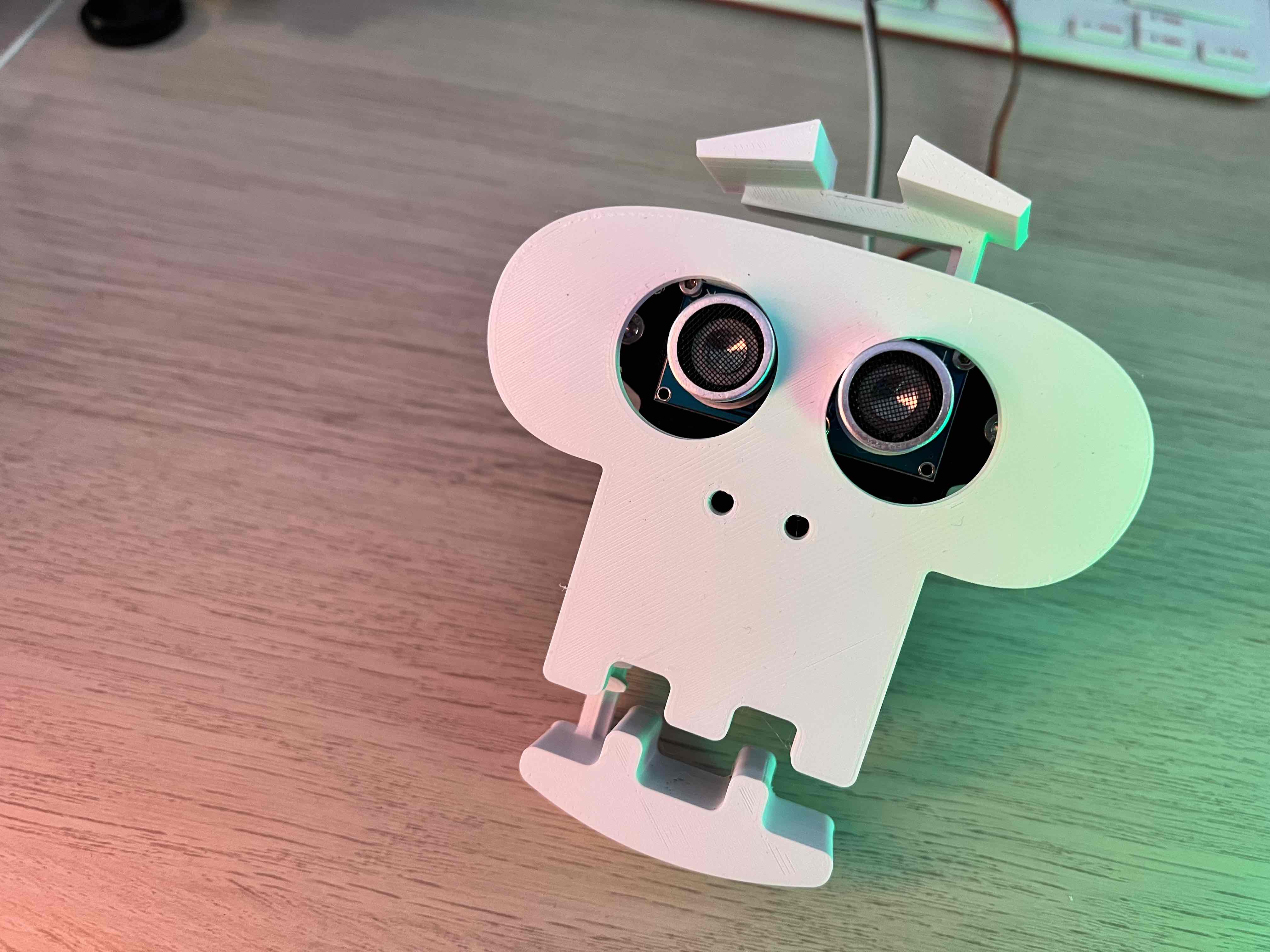
The Spooky Scary Skeleton project is a great first Halloween build — a servo-animated skull that moves to react to its surroundings, built around a Raspberry Pi Pico and a handful of SG90 servos.
For eye mechanisms specifically, the Will Cogley Eyemech build shows how to construct a realistic animatronic eye using 3D-printed parts and SG90 servos. It’s fiddly, but the effect is extraordinary — and exactly the kind of thing that stops trick-or-treaters in their tracks.
If you want to go further with animatronics beyond Halloween, Bottango Basics is a full course on using the Bottango software to choreograph servo movements. It’s the same approach professional animatronic designers use, scaled down to hobby hardware.
Your starter project: build a PIR-triggered blinking eye. Wire a NeoPixel to your Pico, add a PIR sensor, and write a MicroPython script that animates the eye colour when someone walks past. It takes an evening, costs next to nothing, and gets you hooked.
Reacts well with
More Robots & Builds
- SmSMARS
- BbBurgerBot
- PcPicoCat
- DwDrawing Robots
- RaRobot Arms
- RvRovers
- DrDrones
- HuHumanoids
- QdQuadrupeds
- HxHexapods
- PePet Robots
- CbCombat Robots
- RtRetro Robots
Learn more on KevsRobots
Articles to read


Share this element
This page is awesome? Show some love!Did you find this content useful?
If you found this high quality content useful please consider supporting my work, so I can continue to create more content for you.
I give away all my content for free: Weekly video content on YouTube, 3d Printable designs, Programs and Code, Reviews and Project write-ups, but 98% of visitors don't give back, they simply read/watch, download and go. If everyone who reads or watches my content, who likes it, helps fund it just a little, my future would be more secure for years to come. A price of a cup of coffee is all I ask.
There are a couple of ways you can support my work financially:
If you can't afford to provide any financial support, you can also help me grow my influence by doing the following:
Thank you again for your support and helping me grow my hobby into a business I can sustain.
- Kevin McAleer
Comments