KevsRobots Learning Platform
Overview
Assembling the parts
Installing the code
Programming in MicroPython
Upgrades
Line Following Code
Learn how to make BurgerBot follow a line using a line sensor.
By Kevin McAleer, 2 Minutes
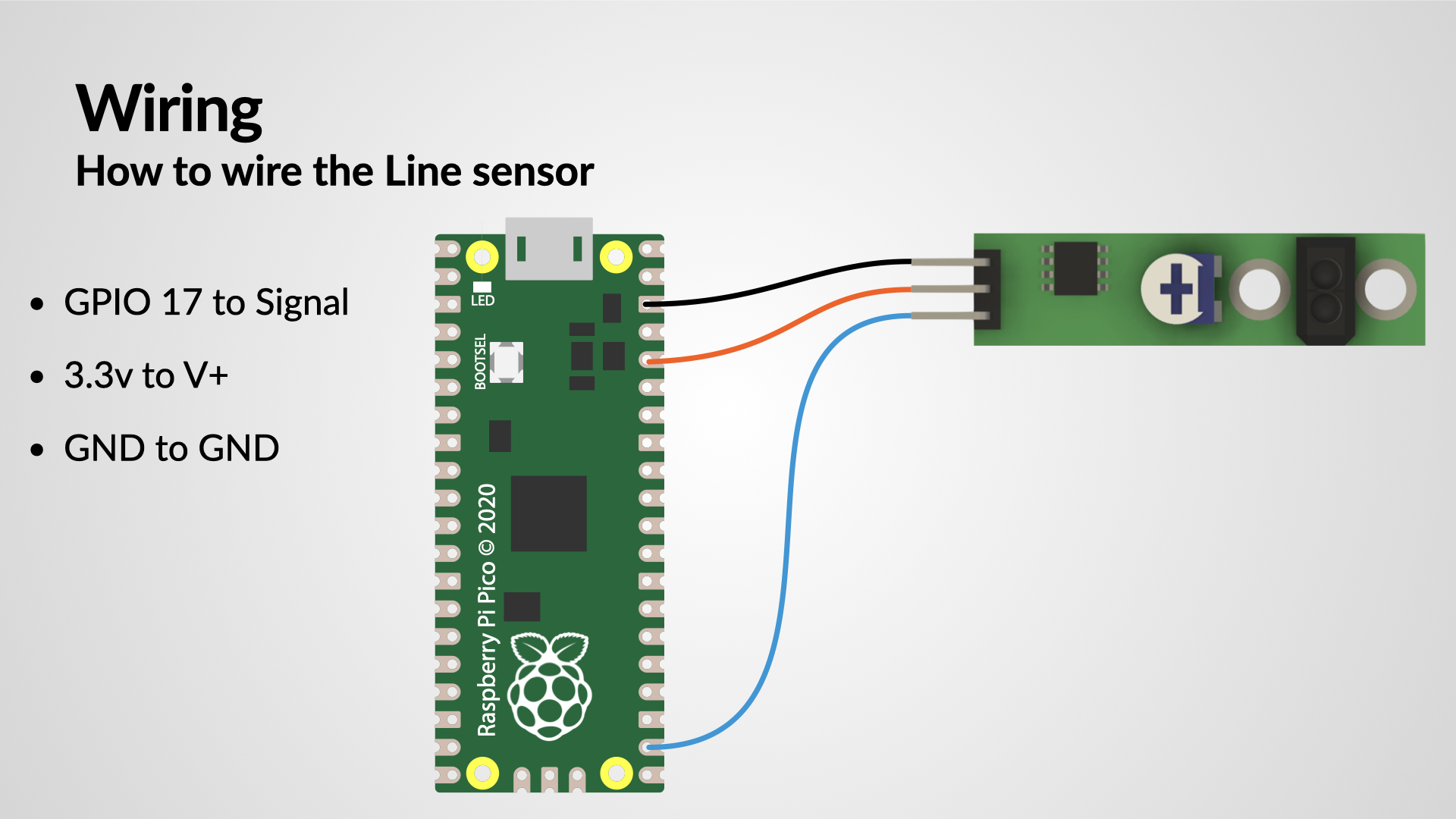
Wiring up the Line sensor
Attach the following wires to the Pico:
| Pico GPIO Pin | Line Sensor | Comments |
|---|---|---|
| 3.3v out | V+ | Solder the end of a female dupont cable to the 3.3v out on the Pico |
| GND | GND | Solder the end of a female dupont cable to the ground (GND) out on the Pico |
| GPIO 17 | Signal | Solder the end of a female dupont cable to GPIO 17 on the Pico |
MicroPython code
The TCRT5000 shines infrared light at the floor and measures how much bounces back. A black line reflects much less than white paper, so the sensor’s output changes when it’s over the line. The library reads this for you with bot.line_detected.
With one sensor, the trick is to follow the edge of the line: turn one way while you can see the line, and the other way when you can’t. The robot wiggles along the edge.
from burgerbot import Burgerbot

bot = Burgerbot()
bot.speed = 0.25          # go slowly so we don't overshoot the line

while True:
    if bot.line_detected:
        bot.left_motor(bot.speed)    # on the line: curve right, off it
        bot.right_motor(0)
    else:
        bot.left_motor(0)            # off the line: curve left, back onto it
        bot.right_motor(bot.speed)
We slow the robot down so it doesn’t go too fast and miss the line, and the loop checks the sensor as often as it can.
Wrong way round?
Depending on your sensor,
line_detectedmay beTrueover white instead of black. If the robot spins in circles, swap the two halves of theif.
Try it yourself
Try different values for bot.speed. What’s the fastest your BurgerBot can go and still stay on the line? Most TCRT5000 modules also have a small potentiometer for adjusting sensitivity.
Quick quiz
How does a single-sensor line follower stay on track?
You can use the arrows ← → on your keyboard to navigate between lessons.
Comments