KevsRobots Learning Platform
Build your own BurgerBot
7% Percent Complete
Overview
Assembling the parts
Installing the code
Programming in MicroPython
Upgrades
Overview
Learn how to build and program Burgerbot, a robot that can move around and avoid objects using a range finder.
By Kevin McAleer, 5 Minutes
Page last updated July 29, 2024
Overview
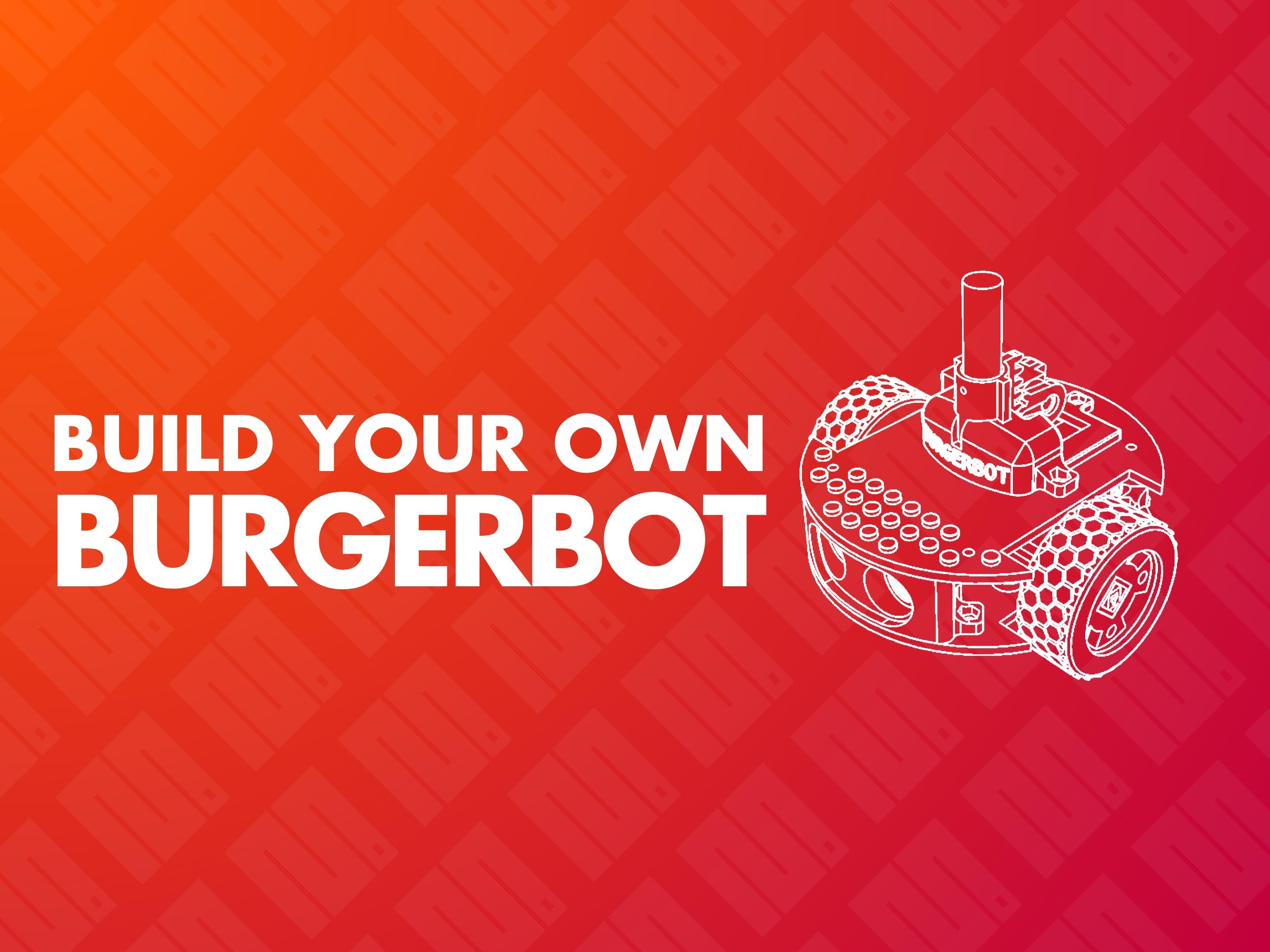
Welcome to the BurgerBot course! BurgerBot is a fun, affordable robot platform perfect for learning robotics, MicroPython programming, and 3D printing. This hands-on course guides you through assembling a burger-shaped robot from 3D-printed parts, then programming it to move autonomously and avoid obstacles.
BurgerBot is designed to be beginner-friendly while teaching real robotics concepts. The robot uses a Raspberry Pi Pico for its brain, two micro metal motors for movement, and an ultrasonic rangefinder for detecting objects. By the end of this course, you’ll have a fully functional robot that can navigate autonomously, draw patterns, and even follow lines!
The best part? All the chassis parts are 3D printable, making this an accessible and customizable robotics platform. Whether you’re new to robotics or looking for a fun weekend project, BurgerBot is the perfect place to start.
Course Content
In this course, you’ll learn:
- What BurgerBot is and why it’s great for learning robotics
- How to 3D print and assemble the robot chassis from scratch
- Installing MicroPython on Raspberry Pi Pico
- Loading code onto your robot using Thonny IDE
- Programming basic robot movement (forward, backward, turning)
- Using an ultrasonic rangefinder to measure distance
- Implementing object avoidance algorithms
- Advanced upgrades: adding a pen for drawing
- Line following capabilities with IR sensors
- Camera integration for computer vision projects
Key Results
After completing this course, you will be able to:
- Assemble a complete robot from 3D-printed parts and electronic components
- Write MicroPython programs to control motors and sensors
- Implement autonomous behaviors like object avoidance
- Understand how differential drive robotics work
- Use the BurgerBot library to simplify robot programming
- Troubleshoot common robotics hardware and software issues
- Expand your robot with additional sensors and capabilities
- Apply these skills to other robotics projects
What you’ll need
Below is a list of parts with links - if you do some research you may be able to find the parts much cheaper.
| Part | Description | Qty | Price |
|---|---|---|---|
| Ultrasonic Range Finder | Measures distance using sound waves | 1 | £6.90 |
| Motor SHIM for Pico | Drives the motors | 1 | £9.60 |
| LiPo SHIM for Pico | Powers the robot via a LiPo battery | 1 | £7.50 |
| Micro Metal Motors | Moves the robot around | 2 | £5.46 |
| Moon Buggy Tyres | Provide grip and traction | 1 | £4.50 |
| Galleon Battery | 400mah hardcase LiPo Battery | 1 | £7.50 |
| SG90 Servo | (Optional) Moves the pen up and down | 1 | £1.99 |
| M2 & M3 Nuts and bolts | For securing the parts together | 14x M3, 6x M2 | Various |
| Total | £48.81 |
Additional Requirements:
- 3D printer access (or order pre-printed parts)
- Raspberry Pi Pico (not included in price above)
- USB-C cable for programming
- Computer with Thonny IDE installed
How the course works
This course combines hands-on hardware assembly with MicroPython programming. You’ll physically build your robot first, then progressively learn to control it with code.
What to expect in each lesson:
- Step-by-step instructions - Clear, numbered steps with images
- Working code examples - Copy and run immediately in Thonny IDE
- Video tutorials - Visual guides for complex assembly steps
- Troubleshooting tips - Solutions to common problems
- Interactive challenges - Practice exercises to test your skills
Learning approach:
- 3D Print - Print the chassis parts (or order pre-printed)
- Assemble - Put together motors, electronics, and printed parts
- Install - Set up MicroPython on Raspberry Pi Pico
- Code - Learn to control motors and sensors with Python
- Navigate - Implement autonomous movement and object avoidance
- Upgrade - Add advanced features like drawing and line following
Each lesson builds on the previous one. The course uses the BurgerBot library to simplify robot control while teaching fundamental robotics concepts.
Note: All code is written in MicroPython for Raspberry Pi Pico. You can copy code directly from lessons or download complete files from the linked GitHub repositories.
Prerequisites
This course is beginner-friendly! You don’t need prior experience with:
- Robotics or robot building
- MicroPython programming (we’ll teach you!)
- 3D printing (basic familiarity helpful)
Helpful (but not required):
- Basic Python knowledge - see Python for Beginners
- Familiarity with Raspberry Pi Pico - see Getting Started with Pico
- Understanding of basic electronics
If you’re completely new to MicroPython, you might want to check out our Learn MicroPython - The Basics course first, but it’s not required - we’ll guide you through everything!
What’s Next
After completing BurgerBot, continue your robotics journey with:
- Line Following Robots - Advanced sensor techniques (covered in BurgerBot upgrades!)
- MicroPython GPIO - Deep dive into hardware control
- SMARS Robot - Build a more complex tracked robot
- MicroPython Robotics - Explore more robotics concepts
You’ll also have the foundation to create your own custom robots and experiment with different sensors and actuators!
Let’s get building your BurgerBot!
You can use the arrows ← → on your keyboard to navigate between lessons.
Comments