
ClawBox Review: A Lovely Box Betting on a Moving Target
An honest look at the ClawBox — a 3D-printed appliance built around the OpenClaw app. Genuinely well made, but is it solving a moving-target problem?
7 June 20264 minute read
By Kevin McAleer
Share this article on
Table of Contents
ClawBox Review: A Lovely Box Betting on a Moving Target
An honest look at the ClawBox — a 3D-printed appliance built around the OpenClaw app. Genuinely well made, but is it solving a moving-target problem?
Video
For every project I create, I often make a corresponding YouTube video. Sometimes, there might be more than one video for a single project. You can find these videos in this section.
Explore more through this this dedicated video.
I’ve been living with the ClawBox for a little while now, and I reviewed it live on stream this Sunday. This is the written version of that review — the same conclusions, just in a form you can skim, bookmark, and argue with in the comments.
Up front, here’s the tension that runs through the whole thing: the ClawBox is a piece of hardware built around a single app, OpenClaw. That’s the most interesting thing about it, and it’s also my biggest reservation. So this is going to be critical — but fair. There’s a lot to like here.
What is it, and what problem is it trying to solve?
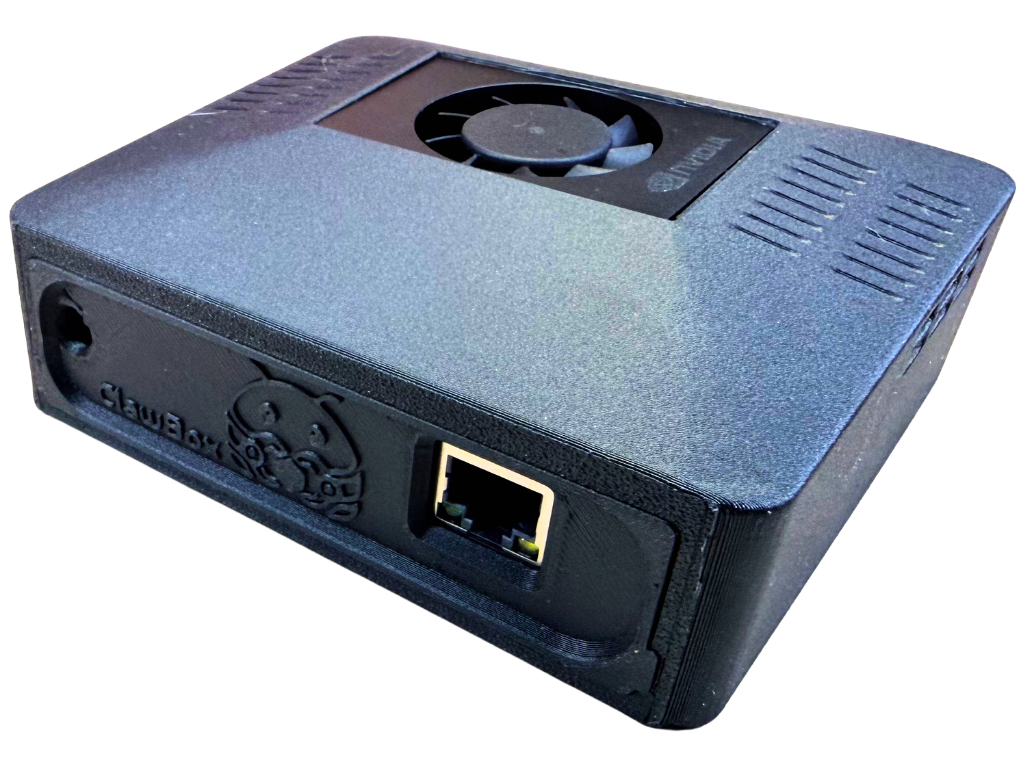
The ClawBox is a compact, 3D-printed box positioned as a dedicated local-AI appliance. Three layers to it:
- Hardware — the box itself, a small dedicated unit you sit on your desk.
- Software — it ships built around OpenClaw as the primary interface.
- Services — it bridges local model execution with cloud AI providers.
The pitch, boiled down, is “plug in and run AI locally without building a rig yourself.” That’s a genuinely appealing promise. The question I kept coming back to is whether the ClawBox actually delivers on it — and whether the way it delivers will still make sense a few years from now.
Build quality
Credit where it’s due: this is a nicely made object. The 3D-printed case is well executed, the tolerances are tight, and it feels considered rather than thrown together.
But there’s a catch, and it’s a big one for a maker audience: there’s no practical way to get inside. The case is effectively sealed. I’m flagging this early because it comes back to bite the ClawBox on both maintainability and long-term value — and we’ll get to both.
What can it do?
Two core jobs:
- Run local LLMs directly on the device.
- Reach out to cloud AI providers via OpenClaw when a local model isn’t enough.
On stream I ran a local model and then a cloud call back to back, because the gap between the two is the kind of thing you have to see rather than read about. Local is private and self-contained; cloud is faster and more capable. The ClawBox tries to give you both behind one interface, and to its credit, that part works.
Who is it for?
This is where it gets awkward.
- Beginners will love that it’s turnkey — no rig to build, no config rabbit holes. But is it priced for a beginner? That’s a real question.
- Experts will appreciate the convenience but quickly bump into the things it won’t let them do: no easy access to the internals, limited I/O.
My honest read is that the ClawBox risks falling into an awkward middle — too locked-down for tinkerers, potentially too pricey for newcomers.
Pros and cons
The good:
- Nicely designed and genuinely well executed.
- A true turnkey local-AI experience — it does what it says.
The not-so-good:
- The cost, especially measured against a traditional mini PC.
- The sealed case — you can’t swap the drive or maintain it in any meaningful way.
- No monitor output and no USB connectivity, which I keep wanting an explanation for.
Value
Here’s the comparison I can’t stop making: for similar money, a traditional mini PC gives you more flexibility, the ability to upgrade, and far more ports. So the real question isn’t “is the ClawBox good?” — it is. It’s “what is the ClawBox premium actually buying you?” The answer seems to be convenience and a polished single-purpose experience. Whether that’s worth the trade is going to depend entirely on you.
My closing thoughts
A few things have been rattling around my head since I started using it.
App-dependency risk. Building hardware around a single app is risky. OpenClaw is software, and software evolves. It may outgrow what this hardware can do, or pivot away from this use case entirely — and then you’re left holding a box.
The Chromebook parallel. Locked-down, single-purpose devices tend to age badly. My original Samsung Chromebook gets slower every year as the world moves on around it, and a sealed AI appliance feels like it’s wearing the same trousers.
The memory-footprint problem. Local LLMs demand ever-larger memory footprints. A box that’s comfortable today could be straining in eighteen months. Will the ClawBox still be useful three years from now, or is it obsolete by design?
That sealed case again. Harder to maintain, and you can’t swap the drive. For a device whose whole value proposition is longevity-of-convenience, locking the door on upgrades is a strange call.
And yet — the design and execution really are genuinely good. I don’t want any of the above to read as a hit piece, because it isn’t one.
Verdict
The ClawBox is a genuinely lovely object solving what I think is a moving-target problem. The single-app, sealed-box bet is the risk: it lives or dies on OpenClaw’s roadmap and on whether local AI’s hardware demands stay still long enough for this box to keep up. They probably won’t.
Would I buy it? I’m not sure — and that uncertainty is the review. If you’ve got one, or you’re tempted, I’d love to hear your take in the comments.
I have a lot of spare compute knocking about the robot lab, in the form of Macs, Raspberry Pis, Arduinos, some older PCs and NAS drives that can run VMs, I’ve also lots of nerdy techy knowledge so for me personally, its not something I would by myself, but I can see the appeal for someone who wants a plug-and-play local AI experience without the hassle of building and maintaining their own rig. It’s a neat piece of hardware, but the long-term value is definitely something to consider before taking the plunge.
This page is awesome - Show some love!


Comments